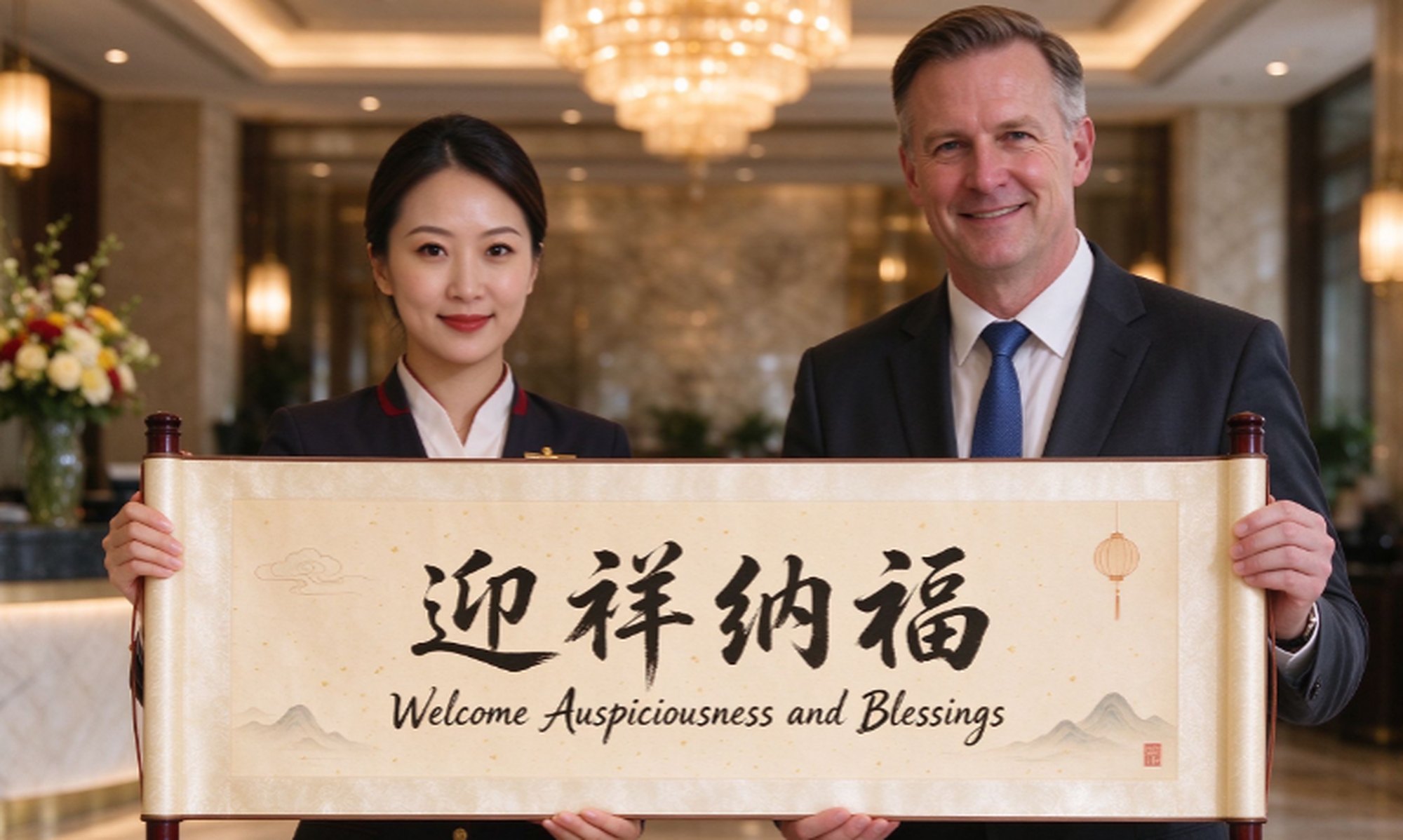
Bespoke ink art gifting is the practice of commissioning a single, hand-painted work on Xuan paper in which the recipient's own language, an auspicious phrase, and a line drawn from corporate culture are written by brush and ink, then mounted for display as a lasting business gift. Unlike a catalogue item ordered in bulk, every commission begins with one conversation and ends with one object that has never existed before and will not be repeated.
Most corporate gifts are forgotten within a season. Branded pens, desk clocks, gift hampers and engraved plaques are produced in the thousands, circulate through offices, and quietly accumulate in drawers. They signal that a budget was spent, not that attention was paid. The gift carries no trace of the person receiving it — no mother tongue, no local idiom, no reference to the relationship it is meant to honour.
Why batch gifts disappear from memory
A mass-produced item is interchangeable: the sender could have given the same object to a hundred other partners, and the recipient knows it. In cross-border relationships this sameness is more than dull; it can read as distance. A gift that ignores the recipient's script, calendar and etiquette suggests the relationship is transactional. By contrast, a work that writes the partner's own language on the wall says the sender studied who they are.
What a single commission actually contains
A bespoke piece is built from a short, verifiable set of elements. The image is painted by hand with ink on Xuan paper; the inscription is rendered in multilingual calligraphy; the finished sheet is mounted with silk or brocade and presented as a hanging scroll, a wall scroll or a framed work; it travels in a brocade box with a collection certificate; and delivery is handled with white-glove care. Commissions start from a single piece — there is no minimum run — because the value lies in uniqueness, not volume.
- Contract signings and the launch of a joint venture
- Company anniversaries and milestone celebrations
- Grand openings and new office inaugurations
- Reception of foreign delegations and visiting guests
- Retirements, farewells and formal thank-you occasions
The etiquette of giving across cultures
Writing a partner's mother tongue is a matter of protocol as much as aesthetics. A phrase chosen with care — a blessing, a line of poetry, a shared value — acknowledges that the relationship crosses a border and that the sender took the trouble to cross it respectfully. The work is meant to be hung, not stored: it becomes part of an office or a home, and because it is one of a kind it can be passed down rather than discarded.
A gift that can be hung, read in the recipient's own language, and handed on is no longer a courtesy — it is a record of a relationship.
How a commission begins
The process moves through clear stages: a conversation about the occasion and the recipient, agreement on the languages and the exact wording, hand painting and calligraphy, mounting and framing, the brocade box and the collection certificate, and finally white-glove delivery. No two commissions follow an identical script, and the wording is always confirmed with the client before the brush touches paper. To see the range of formats, browse the archive; when an occasion is approaching, request a bespoke proposal. Service details are subject to confirmation at the time of enquiry.